

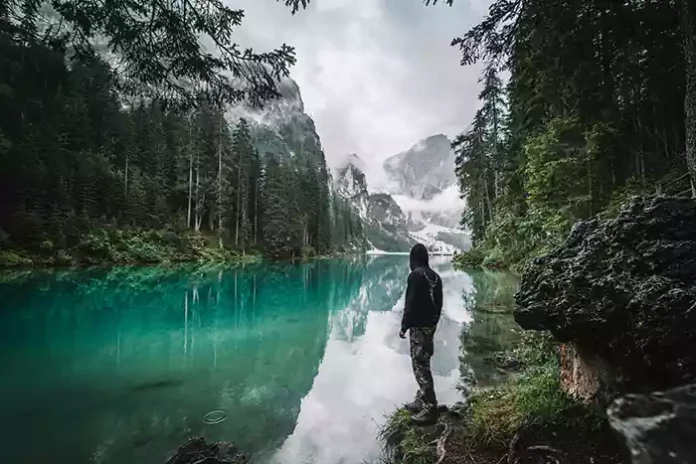
Watching beautiful landscape photos is one of the most enjoyable pastimes. Scenery photography is one of the oldest and most popular styles of photography. I hope discussing landscape photography tips for beginners will be helpful for all fans. We usually have pictures of nature on the walls of our houses. Or we set these pictures as our desktops on our monitors or phone screens. In this guide, I will share practical landscape photography tips for beginners that you can apply immediately in your environment.
Nature often calms the mind and relieves our tiredness. Images taken from nature subconsciously remind us of our desires.
Shooting from forests, lakes, rivers, mountains, beaches, plains, or deserts can produce endless images. People are inspired by watching them and wish to see those places with their own eyes one day.
Each season has its charm. Spring, with its light green color; autumn, with its yellow leaves; and winter, with snow-white, is attractive and impressive.
In this guide you will learn:
- How to choose the right lens
- Best aperture and ISO settings
- When to use ND and polarizing filters
- Composition techniques for natural scenes
Topics
- What kind of landscapes are available to you?
- Decide Where and When to Shoot Landscapes
- Do Not Avoid Repeating the Same Scene
- Technical Basics for Landscape Photography
- Night photography
- Abstract Landscape Photography for Beginners
- Common Subjects in Landscape Photography
- Minimalism
- Common Mistakes in Landscape Photography for Beginners
- Conclusion
- Sources
What kind of landscapes are available to you?
The answer is, in what region and climate do you live? Or where can you travel for scenery photography?
Most of your photos are taken from your climate because this environment is available to you. Sometimes, an interest in photography makes you bear the pain and cost of travel, spend a few days of your daily work, and travel to other areas for more variety in photography.
Many of the most popular landscape photos on social networks are taken in green, humid environments, making them suitable for teaching beginner landscape photography. Photographing lakes, forests, beaches, and waterfalls is gorgeous and captivating.
Unfortunately, I was not very lucky in this regard. There are few waterfalls in my area, and these waterfalls are tiny, with little water flowing in them. We had a lake that was salty but amazing.
Due to climate change, the area of this lake has been drastically reduced for several years and is close to the drying stage. I’m talking about Urmia Lake.
Rivers that were once full of water are now either completely dry or only have water for a few months of the year.
There is no forest at all in this area. Forests form a small area of Iran. If I want to go to the nearest forest, I have to drive hundreds of kilometers. Because there are few forest areas in the country, rich people have come to the woods of other regions, destroyed the forest in the parts along the road, and built villas.
Well, that makes my job more difficult. I can no longer access the forest on the side of the road, and I have to go to the depths of nature with my backpack and camera and lenses on foot. I like this, but it is incompatible with my physical condition.
I hope you are luckier than me. At first, this situation made me very upset. Later, when I saw what exciting pictures some people take of the desert and share them, I changed my mind.
I realized I could take exciting pictures of dry mountains, fields, and almost empty plains.

Decide Where and When to Shoot Landscapes
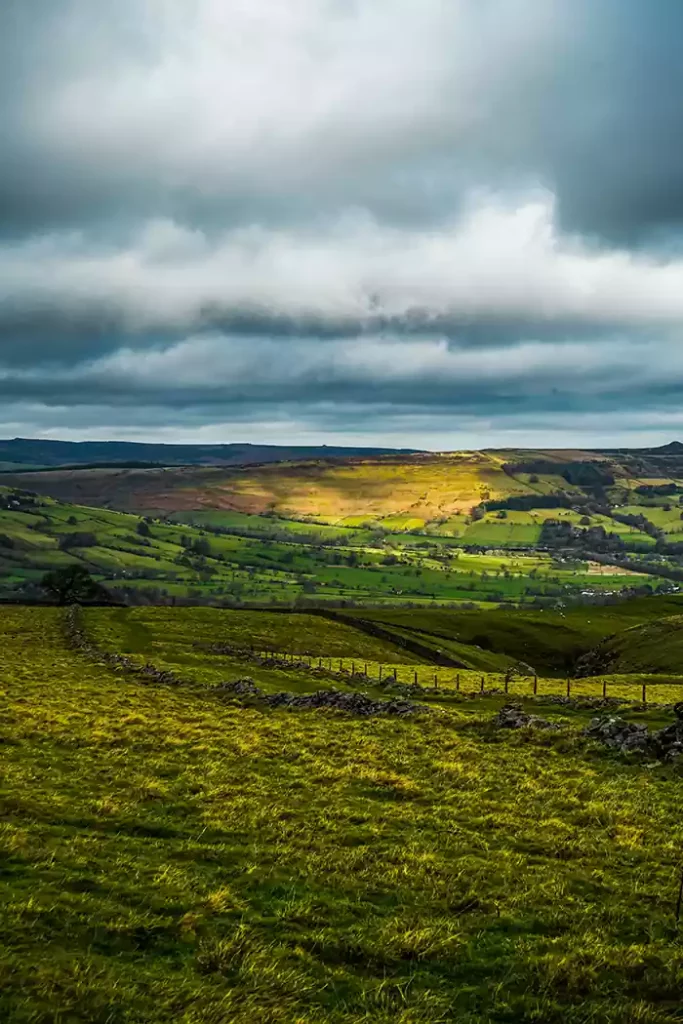
While exploring a location, you may find scenes worth photographing. However, light conditions are not always ideal. In many cases, returning at a different time will significantly improve the result.
There will be times when you will find an exciting scene to photograph. But you will notice that the sunlight angle is unsuitable for this. So next time at another time, you need to go back there.
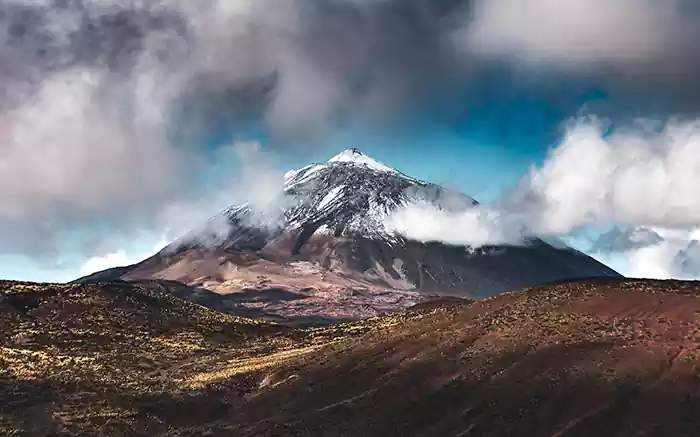
The last thing I want to say is do not be afraid of cloudy and rainy weather. Although such weather will make your job harder, great images will be created. All in all, it’s worth it.
Always check the weather forecast and the sun’s position before heading out.
Do Not Avoid Repeating the Same Scene
As I said before, not only will you have to return to one location due to the light and weather conditions, but it is better to repeat the shooting from different angles and different compositions each time. So that you can get closer to the best.
For example, you might see a view of a valley with several trees. It is interesting. You want to take a picture, so you get out of the car, but you find that the trees near you limit your horizons. So you go lower to get past them. Finally, you take the photo.
Repeating a scene from different angles and positions often leads to stronger compositions. In many cases, a slightly higher or lower viewpoint can remove visual obstacles and improve balance.
Please take a look at the Fine Art Landscape Photos Gallery to see more images
Technical Basics for Landscape Photography
Choosing the Right Lens for Landscape Photography
A wide-angle lens is ideal for capturing expansive scenes, while a telephoto lens helps isolate distant subjects. In some cases, a standard lens provides better control when foreground elements disrupt the composition.
Sometimes the subject is far away from you, for example, there are some trees on a hill, maybe there are animals. In this case, the telephoto lens will help you.
And sometimes, you will find grasses and trees near you disrupt the composition of the image. A wide lens is not suitable for such conditions; it is better to use a standard lens.
Understanding space and depth is fundamental in fine art landscape photography, where composition extends beyond the main subject.
Landscape photography tips for beginners: Aperture and depth of field
In landscape photography, a small aperture such as f/8 to f/16 is often sufficient. These numbers are inversely proportional to the diaphragm’s opening.
The narrower aperture increases the depth of field, which is essential in scenery photography. It will enable components located farther away from the camera to be seen clearly in the image.
However, one disadvantage of using f / 16 to f / 22 is that the light is dim, and you have to slow down the shutter speed.
Tripod and ISO Settings
A slow shutter speed can cause the image to blur due to handshake. Therefore, you must use a tripod if the ambient light is low.
A tripod is essential when using slow shutter speeds. Increasing ISO can help in low light, but higher values may introduce noise. In most cases, a combination of low ISO, small aperture, and a tripod provides the best results
The following solution is to increase the ISO. Depending on the amount of light, you can use ISO 200, 400, or 800. But I do not recommend values higher than that. Because they cause tiny colored spots in the image, removing them in Photoshop is not easy.
In most cases, a small aperture, low ISO, and a tripod will produce the best results.

Filters
Although the use of filters has decreased with modern editing software, some effects are still more effective when captured in-camera.
Polarizing Filter
A polarizing filter reduces reflections from water, glass, and other reflective surfaces. It can also enhance contrast in skies and clouds.
In my experience, shooting clouds with a polarizing filter enhances contrast and saturation—one of my landscape photography tips for beginners!
Neutral Density Filter
ND filters reduce light entering the lens, allowing slower shutter speeds. This is useful for creating motion blur in water, producing a smoother and more dynamic effect.
Soft Graduated Neutral Density Filter
A graduated ND filter helps balance exposure between a bright sky and darker foreground by reducing light in one part of the frame.

Hard Graduated Neutral Density Filter
Hard graduated filters have a sharp transition between dark and clear areas, making them suitable for scenes with a defined horizon.
Conversely, in the soft types of graduated Nd filter, the darkness starts slowly from the middle and gradually intensifies.

Reverse Graduated Neutral Density Filter
Reverse graduated ND filters are useful for sunrise and sunset, where the brightest area is near the horizon.
In this type of ND filter, unlike the Soft Graduated Neutral Density Filter, the darkness starts with the maximum amount in the middle and reaches the minimum at the filter’s edge.ners.

Skylight filter
A skylight filter reduces excessive blue tones and can also serve as basic lens protection.
Night photography
You will need a tripod for night photography. It is better to find a place where humans live. The goal is for the lights to create a view from a distance in the dark.
The shooting location can be a remote village. Or a view of the city that fills the whole area of the picture or a street. The camera must be completely fixed on a tripod because the exposure time will be too long.
Avoid increasing ISO unnecessarily; otherwise, dark areas will be recorded as daylight, a landscape photography tip for beginners! If cars or trains pass through long shots, their effect will remain as light lines in the image, which will be interesting.
Night photography requires a tripod due to long exposure times. Keeping ISO low helps preserve image quality, while moving lights can create dynamic light trails.
Abstract Landscape Photography for Beginners
Abstract landscape photography shifts attention away from recognizable scenes and toward visual elements such as shape, texture, light, and contrast. Instead of documenting a place, it explores how a landscape can be interpreted through simplified forms and selective framing.
This approach is accessible even for beginners. By focusing on patterns in rocks, reflections in water, or the interaction of light and shadow, you can create images that feel expressive without relying on dramatic locations. A small section of a landscape often contains enough visual information to build a compelling abstract composition.
Learning to see these details helps develop a stronger sense of composition. It encourages you to look beyond the obvious view and discover structure within the scene — turning ordinary environments into visually engaging photographs.
This approach is accessible even for beginners and is often explored further in fine art abstract photography, where form and structure become the primary focus.
Common Subjects in Landscape Photography
Clouds
Clouds play an important role in beautifying images. That’s why I told you before that cloudy or rainy weather should not cancel your trip.

Clouds add depth and atmosphere to landscape images. Cumulus clouds create strong visual structure, while cirrus clouds produce softer, more subtle effects.
Cirrus clouds, located at higher altitudes and scattered in the sky, provide a more subtle image.
The completely cloudy sky, especially before or during rain, covers the tops of the mountains and creates a mysterious atmosphere in the valleys, making this image romantic.
Sunlight during sunrise and sunset over the clouds will be unique when the sun is hidden behind an obstacle.
As mentioned above, water on the earth’s surface, such as a lake or a river, increases the image’s attractiveness many times.
Mountains in Landscape Photography
How high are you able to climb? The more you can do, the more valuable it will be. This topic could not be more actual to me. Due to my heavy weight and physical condition, I use a car to climb heights. And so, I am limited to the distance and altitude that the vehicle can climb.
Shooting from higher positions often improves composition by revealing depth and structure. Mountains, valleys, and plains become more visually organized from elevated viewpoints.
A photo taken from a high point of view is unique. All the mountains, hills, and valleys below you will be visible. And, of course, the plain in front will be beautifully seen.
Usually, photography of the plain will be more attractive if done from a higher altitude; one of landscape photography tips for beginners!
Snow mountains are also great subjects for scenery photography. Of course, it is best to use a wide-angle lens, but this is not always possible. For example, if you want to take a picture of a snowy mountain far away from you in the summer, you will need a telephoto lens.
Taking mountain wildlife pictures would be great, but you need a little luck.

Water in Landscape Photography
Water elements such as rivers, lakes, and seas enhance visual interest through reflections and movement, adding depth to the composition.
The view of the beach with rocks or palm trees, the waves of the sea or the twists and turns of a river in its path, and most of all, the amazing views of the waterfalls are great for photography.

Forest Photography in Landscapes
Forest environments offer diverse compositions, from paths and tree tunnels to isolated subjects. A single tree in an open space can create a strong visual focal point.
If you lie on the ground in a dense forest and look at the sky with the camera while the trunks of the trees surround you and the clear sky can be seen through their leaves, you will be able to create a fantastic image; one of landscape photography tips for beginners!
Or, wandering in the forest, you may find a dirt or country road, for which the branches of thick trees seem to have built a roof.
Finding a bridge in the forest or a cottage is possible, all suitable subjects.
Finally, if you find a forest, please take pictures of the trees alone. I have the same problem exactly. A single tree standing alone in a plain can symbolize endurance and hope.
A plain or mountain surrounds it. Although the tree, in such circumstances, is a reminder of endurance and hope for life, it is entirely romantic.

Minimalism
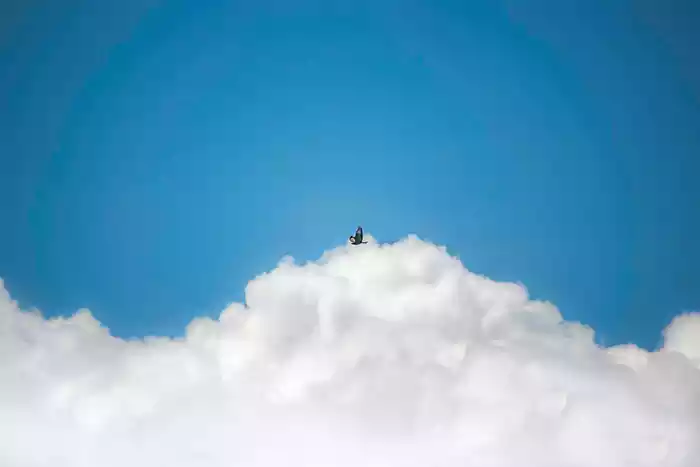
In minimalism, the subject is often small within a large space. This approach emphasizes simplicity and scale, encouraging the viewer to focus on structure rather than detail.
In minimalism, the opposite is true. For example, suppose someone is sitting at the end of a pier, watching the sea. He is the main subject of our photo. However, the photographer uses a wide-angle lens, keeps his distance from the subject, and goes to the pier first to take a picture of him.
The image’s main subject is small, and its details are not precise. We also see the entire length of the pier and the sea surrounding the subject in the picture. Now, the question arises: What was the main subject from the beginning?
Another way is to take pictures of boats in the sea from a distance. Or a few people seem to be walking in the snowy mountains from a great distance. They look like black dots in snow white.
Common Mistakes in Landscape Photography for Beginners
- Using high ISO unnecessarily
- Shooting at the wrong time of day
- Ignoring foreground elements
- Overusing filters
Conclusion
Strong landscape images are created through a combination of composition, light, and patience. Understanding these fundamentals will help you improve your results over time.
Excellent images can be created by photographing forests, rivers, plains, and mountains. Most people enjoy watching such scenes. You just need to be familiar with some basics, such as composition and exposure.
Editing skills can further enhance your images. In dry or low-color environments, converting to black and white can simplify the scene and highlight structure.
If, like me, you live in an area that is relatively dry and has little greenery, converting the image to black and white can help simplify dry or less colorful scenes. All you have to do is leave the house and look for the subject.
Start exploring your surroundings and practice consistently.
